| | Thumbnail | | Creator | Date | Title / Author / Date / Location | Price | | | Description |
| 8085 |  | Details | Beech-Nut Packing Company | 1941 |
| Persuasive Map of Beech Nut Gum Radio Advertising |
|
Beech-Nut Packing Company |
|
| 1941 |
| LOC: |
| $350.00 | Beech-Nut-Packing-Company | Persuasive-Map-of-Beech-Nut-Gum-Radio-Advertising | Unrecorded large-format persuasive advertising map of the United States issued by Beech-Nut for the 1941-1942 radio season, boldly presenting the company’s national broadcast coverage. The country is rendered in bright yellow, overprinted with station call letters in red, while surrounding text proclaims that Beech-Nut advertising combines Red, Columbia, Blue, and Mutual stations "not possible to obtain on any single network." The sheet emphasizes scale and power, noting 172 stations, 38 of them 50,000-watt outlets, and nearly 1,000 Beech-Nut Gum and Beechies ads every week. The result is a striking visual inventory of American radio geography on the eve of World War II.<br><br>
The language makes clear that this was not intended for the general public. Instead, it was designed to persuade wholesalers, grocery chains, druggists, and regional distributors that Beech-Nut’s campaign reached every part of the country at night when radio audiences were largest. By highlighting 50,000-watt clear-channel stations in red and stressing multi-network placement, the map argues that Beech-Nut’s coverage exceeds what any single network could provide. It is, in effect, a sales instrument aimed at convincing the trade that consumer demand was being nationally manufactured and that retailers should stock accordingly.<br><br>
As an artifact, the piece documents a transitional moment in American broadcast advertising, when sponsors strategically assembled cross-network station lists to maximize reach. The map translates invisible airwaves into cartographic form, making corporate media strategy tangible. Combining commercial ephemera with radio history, it stands as an unusual and compelling intersection of cartography, marketing, and early 1940s national media infrastructure. |
| 8079 | 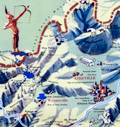 | Details | Sink, John | 1948 |
| Scarce pictorial map of western North Carolina |
|
Sink, John |
|
| 1948 |
| LOC:41 |
| $450.00 | Sink--John | Scarce-pictorial-map-of-western-North-Carolina | Western North Carolina: a vacationist's map and guide is a colorful mid-20th century pictorial map ca. 1948 illustrated by John Sink, a commercial artist known for lively regional tourist imagery. The map presents the Blue Ridge and Great Smoky Mountains as a continuous mountain chain extending from the Tennessee line eastward across western North Carolina ending at the Sauratown Mountains with Hanging Rock State Park.<br><br>
Peaks, gaps, and valleys are shown in bold, sculptural relief, while towns such as Asheville, Boone, and Bryson City anchor the geography. Cartoon figures hiking, skiing, fishing, and sightseeing animate the landscape, emphasizing recreation and leisure ("The Fun") rather than precise navigation.<br><br>
Designed as both a guide and a promotional image, the map combines expressive illustration with practical travel information. Major highways and scenic routes, including the Blue Ridge Parkway, trace the mountain ridges, while airplanes, automobiles, and roadside signage reflect the postwar rise of leisure travel by car and air. An inset conventional road map ("The Hiways") at lower right shows a detailed network of highways serving western North Carolina, reinforcing the sheet's function as both a souvenir image and a usable tourist guide.
<br><br>Text on verso with twelve proposed routes for scenic tours throughout the region. |
| 8077 | 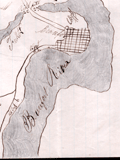 | Details | Unknown Union Source | 1862 |
| The Port Royal Experiment Manuscript Civil War Map Beaufort SC |
|
Unknown Union Source |
|
| 1862 |
| LOC:89 |
| $4,500.00 | Unknown-Union-Source | The-Port-Royal-Experiment-Manuscript-Civil-War-Map-Beaufort-SC | This Civil War–era manuscript map of Beaufort, South Carolina and its surrounding waterways documents the region at the birth of Reconstruction ca. 1862. The map is perhaps the earliest record during what became known as the <b>Port Royal Experiment</b>, when Union occupation, emancipation, and continued military conflict unfolded at the same time. The map shows inland roads, ferries, and navigable rivers, identifies numerous named plantations, and records Union and Confederate picket positions, defensive rifle pits near Beaufort, the battlefield at Port Royal Ferry, and notations of Confederate shelling. It reflects a landscape under Union control but still actively contested.<br><br>The most striking feature of the map is the large number of plantations recorded and the size of the text used to describe plantation ownership vs the military detail. After Union forces captured the Beaufort area in late 1861, most plantation owners fled, leaving more than ten thousand emancipated Gullah people on intact estates without pay, supplies, or legal protection. Beginning in 1862, Northerners arrived to address immediate problems: preventing starvation, organizing paid work, starting schools, and safeguarding newly won freedom for the formerly enslaved. For teachers, missionaries, Treasury agents, and Army officers, a map like this was a working tool. It showed where people lived, where food and cotton were stored, how plantations were connected by roads and waterways, and which routes could be traveled with relative safety. |
| 8059 | 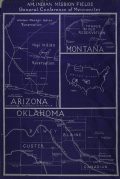 | Details | General Council of Mennonites | 1930 |
| Native Americans Map of Mennonite Missions Interwar Period |
|
General Council of Mennonites |
|
| 1930 |
| LOC:141 |
| $500.00 | General-Council-of-Mennonites | Native-Americans-Map-of-Mennonite-Missions-Interwar-Period | A sigular cyanotype blueprint map issued by the General Conference of Mennonites (GCM) in the late 1920s or early 1930s, this map titled AM. Indian Mission Fields was created as an institutional planning and promotional tool rather than a conventional geographic survey. The map shows roads, towns, GCM fields, and GCM missions in three states: Montana, Arizona, and Montana. An inset map of the United States shows the relative locations of the GCM missions within the United States. Tribes located on the map include the Hopi, Leupp, Cheyenne, the Cheyenne Arapaho, and Navajo.
<br><br>
The map translates complex Indigenous homelands into legible service areas, emphasizing responsibility, access, and administration. What it includes, and what it leaves out, reflects the priorities of the organization that produced it, revealing how Native American lands were visually redefined to support religious outreach and oversight rather than Indigenous sovereignty.<br><br>
Infrastructure plays a central role in this reframing. The map is organized around highways, including the newly established U.S. numbered routes of the late 1920s, transforming Native space into a network of reachable points connected by automobile travel. Roads function here not simply as transportation features but as the map’s underlying logic, normalizing mobility, circulation, and regular visitation. In doing so, the map aligns missionary work with the broader integration of Native regions into national systems of movement and administration during the Route 66 era.<br><br> |
| 8064 | 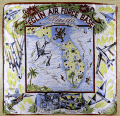 | Details | Anonymous | 1959 |
| Mid century scarf Eglin Air Force Base Florida |
|
Anonymous |
|
| 1959 |
| LOC: |
| $365.00 | Anonymous | Mid-century-scarf-Eglin-Air-Force-Base-Florida | This scarce and colorful mid-20th-century souvenir textile celebrates Eglin Air Force Base, Florida, presenting the installation as a principal proving ground of American air power during the early Cold War. A pictorial map of Florida labeled “Air Proving Ground Command” anchors the design, surrounded by illustrations of jet aircraft, test pilots, target vehicles, and specialized facilities. The textile combines cartographic imagery with promotional aviation art, adapting a souvenir-scarf format widely used for U.S. Air Force bases in the 1950s.<br><br>
The aircraft depicted represent the forefront of U.S. Air Force technology in the supersonic transition era. Shown at mid-left is a B-52 Stratofortress, identifiable by its long straight wings and eight-engine configuration, symbolizing strategic bomber testing. At upper left appears a Lockheed F-104 Starfighter, recognizable by its needle-like fuselage and extremely short wings, while at upper right is a Convair F-102 Delta Dagger, distinguished by its pure delta wing and nose intake. Also depicted is a Republic F-84F Thunderstreak, a swept-wing fighter-bomber widely used in weapons and systems evaluation during the mid-1950s. Additional imagery of test pilots and supersonic tow targets reinforces Eglin’s testing mission.<br><br>
The dating of the textile is supported by both the aircraft selection and the prominent reference to the Climatic Hangar, a facility completed at Eglin in 1954 and widely promoted in subsequent years for extreme-environment testing. The inclusion of the F-102, operational from 1956, and the F-104, which entered U.S. Air Force service in 1958, establishes a firm late-1950s timeframe, while the F-84F reinforces a mid-to-late 1950s context. The absence of later aircraft types or space-age imagery associated with the 1960s further supports an early Cold War date. These elements place the textile most convincingly in the late 1950s, circa 1958 to 1960.<br><br> |
| 8060 | 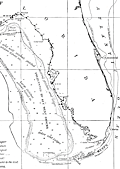 | Details | Goode, G. Brown | 1887 |
| Late 19th Century Map of Gulf Coast Fishing Grounds |
|
Goode, G. Brown |
|
| 1887 |
| LOC: |
| $165.00 | Goode--G--Brown | Late-19th-Century-Map-of-Gulf-Coast-Fishing-Grounds | An early federal fisheries chart of the northern Gulf of Mexico titled <i>Fishing Grounds of the Gulf Coast of the United States</i> (Chart No. 16), covering the coast from the Mississippi Delta and Mobile Bay east to the Florida Keys and Cape Canaveral. The map plots depth soundings in fathoms and outlines key offshore banks and ledges, with dotted boundaries marking the reported limits of the red snapper and grouper fishing grounds. Notes identify the operating ranges of Gulf fishing smacks and indicate principal fishery localities along the shore, capturing a working geography of the region at the height of nineteenth century commercial sail fisheries.<br><br>
Issued as part of the U.S. Fish Commission publication <i>The Fishery Industries of the United States</i> (Section III), the sheet is significant as an early attempt to translate fishermen's local knowledge into a standardized, survey-like document. It helped define where high value reef and bottom fisheries were concentrated relative to depth and distance offshore, information central to the expansion of long range Gulf fishing and the emerging national seafood trade. Today it also serves as a baseline record of fishing grounds and practices before twentieth century industrialization, making it valuable for historians of American maritime economy and for long term environmental comparison.
<br><br>
"The Fishery Industries of the United States". 1887. Section 3. Page 62.<br><br> |
| 8058 | 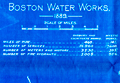 | Details | Boston Water Board | 1889 |
| Boston Water Works Blueprint Plan 1889 Sudbury Cochituate Mystic Water Supply Diagram |
|
Boston Water Board |
|
| 1889 |
| LOC:41 |
| $375.00 | Boston-Water-Board | Boston-Water-Works-Blueprint-Plan--1889-Sudbury-Cochituate-Mystic-Water-Supply-Diagram | |
| 8053 | 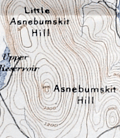 | Details | Appalachian Mountain Club | 1891 |
| Map of the Country About Worcester Compiled by Appalachian Mountain Club |
|
Appalachian Mountain Club |
|
| 1891 |
| LOC: |
| $1,100.00 | Appalachian-Mountain-Club | Map-of-the-Country-About-Worcester-Compiled-by-Appalachian-Mountain-Club | A scarce regional map of central Massachusetts titled <i>Map of the Country About Worcester</i>, published in 1891 by the Appalachian Mountain Club. The map is a sister publication to the Club’s <i>Map of the Country About Boston</i>, issued a year earlier in 1890, and extends AMC coverage westward from the Boston basin into the uplands and river valleys of interior Massachusetts. Only six institutional holdings are recorded in WorldCat, underscoring the map’s scarcity.<br><br>
The maps were compiled from multiple U.S. Geological Survey quadrangle sheets and reduced to a uniform scale. Together, the two sheets extend the Appalachian Mountain Club’s regional mapping beyond the Boston basin into central Massachusetts. Their production reflects the Appalachian Mountain Club’s effort to adapt official government mapping into practical regional maps suitable for recreational, educational, and reference use.<br><br>
The Worcester map appeared in 1891, the same year that <i>The Trustees of Public Reservations</i> was founded, marking a pivotal moment in Massachusetts conservation history. Both initiatives were closely associated with Charles Eliot, an early member of the Appalachian Mountain Club who became its Councilor of Topography in 1890 and was a leading advocate for systematic landscape preservation.<br><br>
As stated in the imprint, the map was “Published by the Appalachian Mountain Club from the proofs of the State map with the permission of the director of the United States Geological Survey and the Commissioners of the Topographic Survey of Massachusetts.” The sheet was lithographed by George S. Harris and Sons, with sales agents W. B. Clarke and Company of Boston and Putnam and Davis, Booksellers, Worcester. |
| 8051 | 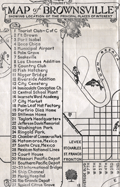 | Details | Cole, C. C. | 1929 |
| Scarce early tourists map of Brownsville Texas |
|
Cole, C. C. |
|
| 1929 |
| LOC:13 |
| $150.00 | Cole--C--C- | Scarce-early-tourists-map-of-Brownsville-Texas | This pictorial tourist map, drawn by C. C. Cole ca. 1929, presents Brownsville, Texas as a civic and recreational destination, combining a rectilinear street grid with illustrated landmarks, river scenery, and playful vignettes of fishing, boating, and wildlife along the Rio Grande and resaca waterways (1). Key sites are keyed in a numbered legend and include Fort Brown, the municipal airport, parks, cemeteries, schools, churches, rail depots, and cross border connections to Matamoros and Santa Cruz, Mexico. Produced in a hand drawn, chamber of commerce style, the map emphasizes accessibility, leisure, and modern amenities while still foregrounding the river, levees, and ship channel that defined Brownsville’s geographic and economic setting.<br><br> The map can be dated to the late 1920s, most plausibly around 1929, based on multiple internal clues. The inclusion of a municipal airport places it no earlier than the late 1920s, while the continued identification of Fort Brown with the 12th Cavalry reflects a period before the post cavalry drawdowns of the early 1930s. References such as Mexican National Lines, the Porfirio Diaz home as a tourist landmark, and the absence of later port and industrial expansions further support a pre 1930s context. The overall booster tone, pictorial style, and civic focus are consistent with chamber of commerce tourist maps produced during the interwar years, pointing to a narrow window just before the Great Depression reshaped local promotion and infrastructure. |
| 8052 | 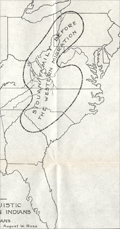 | Details | Connelley, William Elsey | 1920 |
| Lot of two maps Caddoan and Siouan Homelands and Westward Migration |
|
Connelley, William Elsey |
|
| 1920 |
| LOC: |
| $195.00 | Connelley--William-Elsey | Lot-of-two-maps-Caddoan-and-Siouan-Homelands-and-Westward-Migration | Two scarce maps pertaining to the Siouan and Caddoan linguistic families by William E. Connelley. Drawn by August Ross, the maps were published circa 1920.
<br><br>
The first map, titled Map Showing The Possessions Of The Caddoan And Siouan Linguistic Families Of North American Indians Before The Western Migration Of The Siouan's, presents a continental synthesis intended to depict original linguistic homelands rather than fixed political boundaries. The Caddoan family is shown occupying a Mississippi Valley core along the Arkansas, Red, and Platte river systems, while the Siouan family is placed mainly east of the Mississippi River. The enclosed regions represent long-term habitation zones derived from historical tradition, early European accounts, and linguistic comparison. The map establishes the argument that the Siouan peoples were later arrivals to the Plains, displacing an older Caddoan presence.
<br><br>
The second map, Map Showing The Original Caddoan Country After The Intrusion Into It Of The Siouan Linguistic Family, emphasizes movement and territorial contraction. Numbered regions and migration paths depict successive Siouan advances and the resulting fragmentation of Caddoan lands, isolating groups such as the Pawnee and Arikara. River corridors remain central, reinforcing the idea that waterways structured settlement and conflict. In contrast to the first map’s generalized homelands, this sheet focuses on process, showing encroachment, displacement, and the later imposition of reservation boundaries.<br><br> |
| 8047 | 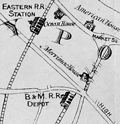 | Details | Little, N. Jr. | 1875 |
| Map of mining lands at Newbury, near Newburyport, Essex County, Massachusetts |
|
Little, N. Jr. |
|
| 1875 |
| LOC:41 |
| $950.00 | Little--N--Jr- | Map-of-mining-lands-at-Newbury--near-Newburyport--Essex-County--Massachusetts | An original late 19th century survey map titled "Map of Mining Lands at Newbury, Near Newburyport, Essex County, Massachusetts", formally entered according to Act of Congress in 1875. Issued separately in a small covered booklet. Drawn by N. Little Jr., the sheet presents a large-scale depiction of the marshlands, waterways, and adjoining uplands of the lower Merrimack and Parker River region. Not much is known about Little but several parcels of land on the map are attributed to N. Little Jr. making the author a very interested stakeholder in the maps' creation and publication.
<br><br>
Executed at a scale of 125 rods to one inch, the map delivers a level of practical detail associated with cadastral and engineering surveys rather than general town mapping. A decorative compass rose anchors the composition at left, while clearly defined town boundaries identify West Newbury, Newbury, Rowley, and Georgetown, with Newburyport situated prominently along the Merrimack River corridor.<br><br>
The map is especially informative in its integration of natural geography, transportation infrastructure, and parcel-level land division. The Merrimack River spans the upper portion of the sheet with the Newbury Flats labeled along the riverfront, while the eastern extent reaches to the Plum Island River, Plum Island, and the Atlantic Ocean, including Salisbury Beach. The Parker River winds through the lower right quadrant, fed by numerous named creeks and surrounded by finely stippled marshland drainage. Two railroad lines, the Eastern Railroad and the Boston and Maine Railroad, are clearly drawn and labeled, reinforcing the economic context of the survey. Throughout the central and southwestern areas, dense subdivision lines and owner-name annotations document individual parcels within the designated mining lands, confirming the map’s function as a legal and developmental instrument rather than a purely descriptive view of the region.<br><br> |
| 8041 | 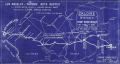 | Details | Hall, Dick Wick | 1920 |
| Rare Salome Road Map by Dick Wick Hall Los Angeles to Phoenix |
|
Hall, Dick Wick |
|
| 1920 |
| LOC:89 |
| $1,450.00 | Hall--Dick-Wick | Rare-Salome-Road-Map-by-Dick-Wick-Hall-Los-Angeles-to-Phoenix | Very rare unrecorded, hand-drawn road map, issued as a blueprint, of central Arizona and California, west of Phoenix by promoter, humorist, publisher, columnist and entrepreneur Dick Wick Hall. Inset note for aviation landing fields, rare on road maps of this era. Hall's initials D.W.H. at bottom right corner.
<br><br>
<div id="0" align="center">
<a title=""></a>
<img id="8041" src="/ZoomifyImages/SC_8041/SC_8041_Frog.jpg" alt="Dick Wick Hall's Famous Salome Frog." width="300"/> <br><br> <font size="-2">Hall's Famous Salome Frog<br> At the Laughing Gas Station. Salome AZ.</font>
</div><br>
Dick Wick Hall founded Salome, Arizona in 1904 as part of a speculative desert development venture along a proposed railroad route in western Arizona. He soon became the town’s most visible booster, operating a roadside service station, promoting travel through the desert, and cultivating a larger-than-life persona that blended entrepreneurship with humor.
<br><br>
Dated to 1920 based on a very similar map published by Hall in his Salome Sun mimeographed newspaper he published between 1920 and 1926. <div class="indenttextblock"><i>" ... the paper was likely intended to be supplied to service stations, such as the one Hall owned in Salome, or other road stops for the traveler passing through, as each issue contains short quips written by Hall about road trips, Yuma County, stories about the desert and driving in the southwest. The paper also often contains cartoonish illustrations of common southwest wildlife, from snakes to scorpions and cacti, as well as regularly featuring a cartoon frog by the name of the Salome Frog who regularly declares that he cannot swim."</i> </div> (Reference: State of Arizona Research Library. Online. https://azmemory.azlibrary.gov/nodes/view/328579).<br><br> |
| 8039 | 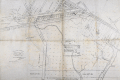 | Details | Mason, W.A. | 1887 |
| Unrecorded Manuscript Trace Cambridgeport Lands Frederick Lothrop Ames |
|
Mason, W.A. |
|
| 1887 |
| LOC:1401 |
| $2,750.00 | Mason--W-A- | Unrecorded-Manuscript-Trace-Cambridgeport-Lands-Frederick-Lothrop-Ames | A large, unrecorded pen and ink trace map on tracing cloth depicting lands on the Charles River Flats then held by the estate of Frederick Lothrop Ames (1) and associated owners, on the site now occupied by the Massachusetts Institute of Technology. The map was copied by William H. Whitney after Mason in the same month that the Massachusetts Legislature passed legislation that forced the cities of Cambridge and Boston to build the Harvard Bridge and share costs (2). Some portion of the map is attributed in pencil to a blueprint in Ames' possession, likely by W. A. Mason. Verso with the oval blue ink overstamp of William H. Whitney and index number 313.
<br><br>
The map was prepared in 1887, at a moment when the Charles River Embankment Company had begun construction of its granite seawall and was actively filling the Charles River Flats with dredged material from the river. It shows significant detail of the hydrography of the area including height in feet above low water at spring tide and the course of several small waterways including a detailed survey of Goff's Cove.
<br><br>Using the west line of the proposed Main Street extension, later realized as the Harvard Bridge, as a fixed boundary, and reading the notation on the mapped boundary, it appears Ames had already deeded lands west of this line to the Embankment Company. This drawing would have served as the working basis for negotiations over the remaining eastern portion of the Flats still under his ownership.
<br><br>
The sheet approximately covers the Charles River Flats from the navigable canal on the east to Goff's Cove on the west, and from the Boston and Albany Branch Railroad south to the planned 200 foot parkway along the riverbank. Detailed annotations at center record precise parcel boundaries totaling more than 2.3 million square feet and specify the fractional ownership interests of four parties, including Ames and the Charles River Embankment Company. Scale 80 feet to 1 inch.
<br><br> |
| 8038 | 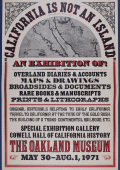 | Details | Anonymous | 1971 |
| Rare California Is Not an Island Oakland Museum Poster |
|
Anonymous |
|
| 1971 |
| LOC:130 |
| $400.00 | Anonymous | Rare-California-Is-Not-an-Island-Oakland-Museum-Poster | An original 1971 exhibition poster “California Is Not an Island,” produced for a special show at the Oakland Museum (Cowell Hall of California History), held May 30 to August 1, 1971. Designed in a bold nineteenth century broadside style with heavy slab-serif lettering in red and black, the sheet advertises an exhibition centered on early documentary materials relating to California’s exploration, overland migration, and Gold Rush-era development. <br><br>At the top is a halftone reproduction of a later embellished edition of Nicolas de Fer's map of California "La Californie ou Nouvelle Caroline", preserving the insular outline and early eighteenth century geographical nomenclature. The reference to Father Eusebio Kino acknowledges the Jesuit explorer whose overland expeditions proved that California was a peninsula, a conclusion directly contradicted by the island form shown here and central to the exhibition’s theme.<br><br>
The body of the poster lists the exhibit’s scope: overland diaries and accounts, maps and drawings, broadsides and documents, rare books, manuscripts, prints, and lithographs. The emphasis on primary sources underscores the museum’s intent to demonstrate how early travelers, scientists, and explorers recorded the region and how these records shaped the narrative of westward movement and the building of the transcontinental railroad. Only two publicly recorded sales of this poster are known.<br><br>
Only two sales of this poster are recorded on the Internet.
<br><br>
The Oakland Museum of California opened during 1969, created from the merger of three older institutions devoted to art, history, and natural science. Housed in a landmark terraced concrete complex by architects Kevin Roche and John Dinkeloo, it was conceived as a new kind of interdisciplinary museum dedicated to the story of California. |
| 8034 |  | Details | Mayson, Thomas | 1875 |
| Victorian exhibition advertisement for Mayson’s Relief Ordnance Model |
|
Mayson, Thomas |
|
| 1875 |
| LOC:89 |
| $200.00 | Mayson--Thomas | Victorian-exhibition-advertisement-for-Mayson’s-Relief-Ordnance-Model | Original Victorian exhibition advertisement for Mayson’s 3D Ordnance relief model of the Lake District, Cumbria, North West England, created in 1875 as a major visitor attraction in Keswick. The broadside announces the enormous 210 square foot model exhibited daily at the Lake District Repository on Lake Road, a sculpted landscape built to a scale of six inches to the mile and rendered with exactness from Ordnance Survey data. Bold Victorian lettering, fern motifs, and a vignette of the Repository building frame the promotional text, which highlights mountains, lakes, rivers, waterfalls, villages, and roads shown in full relief and hand colored to nature.
<br><br>
The model was commissioned by Keswick photographer Henry Mayson and his brother Thomas and built by the Italian sculptor Raffaelle Monti and his team using Ordnance Survey sheets as the mathematical basis for every contour. The advertisement stresses its practical value for travelers, noting that the model was an essential tool for planning excursions and understanding the correct topography of the Lake District at a time when tourism was rapidly increasing. Daily opening hours, illumination during summer months, and a one shilling admission charge appear prominently in the lower text block.
<br><br>
As an example of nineteenth century exhibition ephemera, this poster documents one of the most ambitious public relief models ever constructed in Britain and preserves the original marketing for a landmark Lake District attraction. Surviving advertisements for Mayson’s Ordnance Model are scarce, and this sheet stands as a desirable item for collectors of British posters, Lake District history, and early Ordnance Survey derived cartography. |
| 8036 | 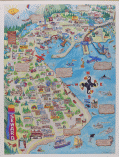 | Details | Nadon, Paul and Sandi | 1985 |
| Colorful pictorial advertising poster of Seward, Alaska |
|
Nadon, Paul and Sandi |
|
| 1985 |
| LOC:130 |
| $325.00 | Nadon--Paul-and-Sandi | Colorful-pictorial-advertising-poster-of-Seward--Alaska | Colorful pictorial poster map of Seward, Alaska, drawn by Paul and Sandi Nadon and published by New Sensations in 1985. The sheet presents the harbor town of Seward on Resurrection Bay as a busy cartoon landscape, with streets, businesses, and waterfront activity rendered in bright hand drawn vignettes rather than formal cartography. A large vertical Seward banner along the left margin, smiling sun over the Kenai Mountains, and playful notes in the margins firmly place the map in the late twentieth century tourist boom along the Alaska coast.
<br><br>
Within the town grid the artists label motels, cafes, shops, churches, and civic buildings, while the surrounding hills show wildlife, waterfalls, and campgrounds. The harbor is packed with cruise boats, fishing vessels, sailboats, and float planes coming and going from Resurrection Bay, all keyed to short text panels that highlight local attractions such as the Silver Salmon Derby. A puffin shaped compass rose, orcas, sea otters, and seabirds enliven the water, and humorous scenes on land convey the easygoing character of Seward as a working port and visitor destination.
<br><br>
More than a simple street plan, the poster functions as an illustrated directory of mid-1980s Seward, preserving the look of its downtown businesses, harbor facilities, and tourist culture at a particular moment in time. The map should appeal to collectors of Alaska ephemera, pictorial map posters, and American roadside tourism, it is an engaging wall piece that rewards close inspection, with dozens of local references and comic details scattered across the sheet.
<br><br> |
| 8037 | 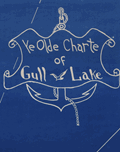 | Details | Conrad, Maynard | 1955 |
| Ye Olde Charte Of Gull Lake Kalamazoo County Michigan |
|
Conrad, Maynard |
|
| 1955 |
| LOC:130 |
| $375.00 | Conrad--Maynard | Ye-Olde-Charte-Of-Gull-Lake-Kalamazoo-County-Michigan | Mid twentieth century blueprint pictorial map of Gull Lake in Kalamazoo and Barry Counties, Michigan, with hand-drawn shorelines, compass rose, and whimsical period lettering. The sheet captures the resorts, parks, beaches, and cottages that once ringed this deep spring-fed lake north of Kalamazoo, documenting the area as a regional leisure destination. The artist, Dr. Maynard Conrad (d. 1998) uses simple white linework on blue background to present an engaging portrait of the lake at a time when summer colonies, canoe clubs, and motor launches were beginning to reshape the shoreline.
<br><br>
The map highlights a tight cluster of neighboring lakes that define the Gull Lake region. Little Long Lake and Miller's Lake appear to the northwest, while Grassy Lake is shown just beyond the isthmus that separates Gull Lake from its smaller companions. These lakes form part of a distinctive kettle-lake chain created by the region's glacial geography, a landscape that helped establish Gull Lake as one of the most celebrated inland waters of southwest Michigan. The sheet also notes well known features of the day, including Idlewild, Ross Township Park, Island Park, Crescent Beach, the Country Club grounds, and the string of cottages along Lover's Lane.
<br><br>
This pictorial blueprint serves equally as a regional souvenir and a record of community identity around Gull Lake. Resorts such as Bayberry Inn, Hickory Point, and Walnut Inn, together with family parks, bird sanctuaries, and boat landings, illustrate a thriving recreational culture. Surviving large format blueprints of local lakeside development are scarce, and this example offers collectors an attractive combination of graphic charm, local history, and early twentieth century Michigan cartographic style. |
| 8030 | 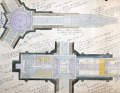 | Details | Crowder, Cyril C. | 1935 |
| Crowder Variable Expansion Propeller Design Drawings |
|
Crowder, Cyril C. |
|
| 1935 |
| LOC:130 |
| $300.00 | Crowder--Cyril-C- | Crowder-Variable-Expansion-Propeller-Design-Drawings | These three manuscript drawings are a striking artifact of early aviation ingenuity, capturing a bold experimental idea that never left the drafting table. Their meticulously rendered telescoping blades, mechanical sections, and handwritten annotations reveal a level of detail and ambition rarely seen in surviving 1930s aeronautical work. As a display piece, it stands at the intersection of engineering art and aviation history: visually compelling, technically imaginative, and representing a line of research that was too impractical for its time or even for today. Framed, it becomes not just a engineering drawing but a cool conversation piece about the inventive spirit of early flight and the folly of some inventors.
<br><br>
Crowder's variable expansion propellor was designed by Cyril C. Crowder of Hollywood, California. No information is found online about the designer nor is any patent found for the design.<br><br> |
| 8024 | 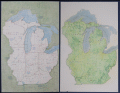 | Details | Paine, Howard E. | 1975 |
| Manuscript conceptual maps for Great Lakes–Midwest region |
|
Paine, Howard E. |
|
| 1975 |
| LOC:130 |
| $500.00 | Paine--Howard-E- | Manuscript-conceptual-maps-for-Great-Lakes–Midwest-region | Unpublished poster-size manuscript conceptual map ca. 1975 by National Geographic Art Director Howard Paine (1) presents a unified Great Lakes–Midwest region extending from Lake Superior to central Kentucky. Rendered in soft colored pencil and wash, the sheet studies regional physiography—rivers, watersheds, and upland structure—without the finished editorial layers of a production map. Paine experiments with state boundaries, drainage patterns, and implied landcover to test how a broad Midwest–Great Lakes treatment might read at atlas scale.
<br><br>
The verso carries a companion terrain study in the same hand, emphasizing elevation, forest cover, and hydrology with Paine’s characteristic, lightly modeled shading. Together the two drawings show the internal design process behind a National Geographic map that was never realized in print, offering a rare look at the developmental artwork that preceded formal cartographic production. They are among the few surviving privately-held examples of Paine’s pre-press regional concept work.<br><br> These conceptual sheets can be securely dated to the late 1960s through the mid-1970s, the period when National Geographic relied on hand-rendered shaded-relief masters and watercolor terrain studies for both its Atlas of the World (6th–8th editions) and the Close-Up U.S.A. series. The green land wash, blue-gray lake treatment, and pencil-modeled hydrology match the Society’s internal cartographic style of roughly 1968–1977, placing Howard Paine’s drafts squarely within that high phase of Nat Geo’s pre-digital map production. |
| 8020 | 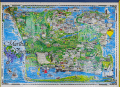 | Details | White Mountain Graphics | 1981 |
| Illustrated Pictorial Map of Martha’s Vineyard |
|
White Mountain Graphics |
|
| 1981 |
| LOC:130 |
| $300.00 | White-Mountain-Graphics | Illustrated-Pictorial-Map-of-Martha’s-Vineyard | A colorful illustrated poster map of Martha's Vineyard drawn by K. Rinaldo and published in 1981 by White Mountain Graphics. The poster is filled with hundreds of hand-drawn vignettes capturing island towns, harbors, beaches, landmarks, and summer pastimes. The artist uses a cartoonlike style to show ferries approaching Vineyard Haven, sailboats in Katama Bay, lighthouses, beaches, farms, and well-known establishments across Oak Bluffs, Edgartown, and Chilmark. Inset scenes, handwritten labels, humorous details, and decorative border elements give the sheet the character of a personal visual tour rather than a formal cartographic product.
<br><br>
The map functions as a record of Vineyard culture, highlighting cottages, inns, restaurants, bicycle routes, fishing spots, and community traditions that defined the island during the period. Its composition rewards close viewing, with dozens of local references rendered in a bright palette intended to evoke the island's summer energy. A striking pictorial map for collectors of Vineyard ephemera and American resort-town cartography.
<br><br>
White Mountain Graphics was a small New Hampshire-based illustration and design studio active primarily in the late 1970s and early 1980s. Operating out of Jackson, New Hampshire, the firm produced a range of commercially printed posters, pictorial maps, and souvenir-oriented visual materials, often in a hand-drawn style similar to the Martha's Vineyard map.
<br><br> |
| 8022 |  | Details | Civic Pride Inc. | 1999 |
| Y2K Silicon Hills Weird Austin Texas Technology Calendar Map |
|
Civic Pride Inc. |
|
| 1999 |
| LOC:130 |
| $500.00 | Civic-Pride-Inc- | Y2K-Silicon-Hills-Weird-Austin-Texas-Technology-Calendar-Map | Few artifacts from the Y2K period embody Austin’s “Keep Austin Weird” identity as vividly as this eccentric promotional panorama of Silicon Hills at the dawn of Y2K.<br><br>Instead of the clean corporate campuses and tidy geography found on Silicon Valley ecosystem calendar maps, this poster erupts with visual wordplay: cartoon workers being launched skyward at Catapult Systems, janitors mopping an actual interstate near Interstate Building Maintenance, and chip-shaped rockets lifting off with passengers at Rocket Chips. Even the Outernet cluster drifts into sci-fi territory, with tiny figures reaching toward planets and swirling galaxies placed behind the company’s logo.<br><br>The map doubles as a corporate directory and a cartoon stage, with human figures literally acting out company names. Workers climb ladders into the sky, pose as greeters in front of favored start-ups, crowd between competing firms, and interact with floating planets and chip-rockets. These pun-driven scenes have no equivalent in Silicon Valley ecosystem maps, which generally stay anchored in real geography. Here, the illustrator abandons that convention entirely, letting humor and visual wordplay override any sense of place.<br><br>Against this surreal landscape, the Y2K calendar along the bottom edge adds a surprisingly earnest note, grounding the piece in a moment of real technological concern. The dense layering of logos, theatrical human activity, and playful chaos captures Austin’s tech boom at its most unconventional—an ecosystem expanding quickly, behaving unpredictably, and proudly diverging from the slightly more polished, sober aesthetic of its California and Arizona counterparts. |
| 8019 |  | Details | Taylor, Joseph | 1814 |
| Land Travelers Pocket Compass of Winds and Weather |
|
Taylor, Joseph |
|
| 1814 |
| LOC:78 |
| $550.00 | Taylor--Joseph | Land-Travelers-Pocket-Compass-of-Winds-and-Weather | Early 19th-century "Land Traveller's Pocket Compass," engraved and issued by Joseph Taylor. This is only the second example of this work by Taylor we can locate. No example of the item is found in WorldCat.
<br><br>Taylor prepared these pocket compasses for travelers, surveyors, and outdoorsmen who needed a simple guide for direction finding and basic weather prediction. The circular diagram is built from several engraved rings of text explaining how rainbow color, phase of the moon, and compass bearing of specific meteorological phenomena (wind, clouds, rain) were believed to signal approaching changes in the weather. These ideas reflect the early folk-meteorological rules that Taylor promoted in his printed work: "A rain-bow in the morning is the Shepherd's warning; but a rain-bow at night is the shepherd's delight."
<br><br>
Published for J. Taylor in 1814. With a manuscript dedication at bottom right: "From your lonely husband in Britain. 1943."
<br><br>
The piece blends practical instruction with decorative engraving. The central compass rose is surrounded by Taylor's explanatory text, while two ribbon panels carry short rules for reading clouds and winds. Although inexpensive and meant for everyday use, few examples survive because they were handled, carried, and eventually discarded. This sheet is therefore a rare artifact of early British scientific engraving and an unusual example of Joseph Taylor's work at the intersection of silversmithing, printing, and popular science. |
| 8016 |  | Details | Bower, N. E. | 1902 |
| Map of the U.S. Military Reservation, Fort Sill, Oklahoma Territory |
|
Bower, N. E. |
|
| 1902 |
| LOC:130 |
| $2,400.00 | Bower--N--E- | Map-of-the-U-S--Military-Reservation--Fort-Sill--Oklahoma-Territory | Unrecorded and important 1902 blueprint map documents the entire U.S. Military Reservation at Fort Sill, Oklahoma Territory, just five years before Oklahoma statehood and one year after the last Indian lands in Oklahoma opened for settlement. Compiled and drawn under the supervision of 2nd Lt. N. E. Bower, Corps of Engineers, the map was prepared for a Board of Officers convened on November 6, 1902 to review and verify the reservation’s boundaries, fences, roads, streams, and terrain. It presents the reservation in three components -- the Original Reservation, the Western Addition, and the Eastern Addition -- with detailed Public Land Survey System grids, contour lines, drainage, and the developed cantonment near Medicine Bluff Creek.<br><br>With the frontier gone and the cavalry mission fading, the fort shifted toward a new role as artillery units arrived, including the formation of the 39th Field Artillery Battery in 1902. This transition ultimately saved the fort from closure, and with the last cavalry regiment departing in May 1907, Fort Sill was firmly on the path to becoming the home of U.S. Army Field Artillery.<br><br>This map captures that transition with precision, drawing on General Land Office surveys, U.S. Engineer triangulations, earlier post maps, and contemporary field notes. Today the blueprint stands as an important visual record of the boundaries and landscape of one of the nation’s most significant western military posts, known as the later home of the Field Artillery School and the final residence of the Apache prisoners of war, including Geronimo.<br><br> |
| 7999 | 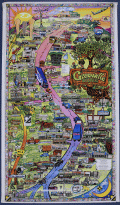 | Details | Landmark Adventures | 1992 |
| Greeville Avenue Dallas Texas Pictorial Map |
|
Landmark Adventures |
|
| 1992 |
| LOC:130 |
| $500.00 | Landmark-Adventures | Greeville-Avenue-Dallas-Texas-Pictorial-Map | This illustrated pictorial promotional poster map titled “Greenville Avenue: A Landmark Adventure – Dallas, Texas” depicts the full commercial corridor of Greenville Avenue using dense line-art drawings of individual businesses, landmarks, and street features. Drawn by Jack B. Weidner. Copyright Landmark Adventures, 1992-1993.
<br><br>The artwork organizes the avenue vertically, with north at the top, and identifies a large number of local establishments including restaurants, bars, boutiques, clubs, real-estate offices, and service businesses. Notable sites shown include the Doubletree Hotel, Old Town Shopping Center, Ada Art Gallery, Rollins, Corinthian Sailing Club, Pepe’s & Mito’s, The Diner, John’s Café, Flip’s, Nick’s Café, and many others. Corporate sponsors such as the Dallas Cowboys, Pepsi, Coors, RE/MAX, American Airlines, 94.5 The Edge, and Landmark Adventures appear within the composition, indicating commercial support at the time of publication. The map also includes playful vignettes—cars, pedestrians, musicians, hot-air balloons, aircraft, and neighborhood scenes—presented in a visually busy style meant to capture the character of the district.
<br><br>
Directional labels (Deep Ellum, McKinney Avenue), street names (Ross Avenue), and inset business directories help orient the viewer, while the border incorporates a decorative pattern consistent with late-20th-century pictorial map design. The poster functions as both a promotional guide and a snapshot of Greenville Avenue’s retail environment at the time it was created, documenting a concentration of independent businesses alongside well-known local institutions. As ephemera, it records the commercial identity of one of Dallas’s most recognizable streets and provides a detailed reference to storefronts and neighborhood culture that may no longer exist in the same form today. |
| 7992 | 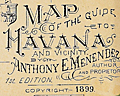 | Details | Menendez, Anthony E. | 1899 |
| Map of Havana and Vicinity |
|
Menendez, Anthony E. |
|
| 1899 |
| LOC:86 |
| $250.00 | Menendez--Anthony-E- | Map-of-Havana-and-Vicinity | First edition map of Havana, Cuba and the surrounding area. Copyright 1899. Small inset coastal recognition view of the lighthouse and Morro Castle at the entrance to Havana Harbor opposite la Punta.
<br><br>
Scarce 1899 tourist map of Havana, Cuba, compiled and published by Anthony E. Menendez as the “Map of the City of Havana and Vicinity,” issued as the 1st Edition. Printed with a full street grid and surrounded by extensive indexes, the map identifies streets, parks, plazas, churches, markets, government offices, public buildings, hospitals, theaters, banks, and railway stations using an alphanumeric reference system. Major military and harbor defenses—including Morro Castle, La Cabaña, and La Punta—appear as engraved vignettes, along with illustrations of key civic structures across the city.
<br><br>
The plan captures the arrangement of Havana at the turn of the twentieth century during the U.S. military administration following the Spanish–American War. The city’s waterfront, harbor entrance, wharves, and ferry routes are clearly plotted, and the western suburbs and parklands are shown with their developing street patterns. A large inset at lower right depicts the Grand Hotel Pasaje, while advertising across the top margin promotes the “Cuba” brand cigarette, indicating commercial distribution of the map.
<br><br>
A detailed and visually engaging guide-map from a pivotal moment in Havana’s history, notable for its combination of practical indexing, architectural vignettes, and period promotional material. |
| 7991 | 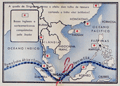 | Details | Wehrmacht Propaganda Service | 1942 |
| German WWII propaganda poster Japanese capture of Singapore |
|
Wehrmacht Propaganda Service |
|
| 1942 |
| LOC:130 |
| $450.00 | Wehrmacht-Propaganda-Service | German-WWII-propaganda-poster-Japanese-capture-of-Singapore | Scarce German propaganda poster from World War II produced by the Wehrmacht Propaganda Service following the fall of Singapore in February 1942. Once considered the “Gibraltar of the East,” Singapore’s swift collapse to Japanese forces was seized upon by German propagandists to ridicule Britain’s waning imperial power and the failure of Allied defenses in Asia.
<br><br>
Titled “Singapura em poder dos japoneses,” the poster presents four scenes of Japanese troops advancing through jungle terrain, tanks on the move, and aircraft strafing the island’s airfields. At the center, a map dramatizes the Allied supply routes to Singapore being severed—depicted with a pair of scissors—and highlights captured British and American bases throughout the South China Sea, the Philippines, and Malaya, symbolizing the Axis narrative of unstoppable Japanese expansion.<br></br>
Only two examples of this poster are found in WorldCat.
<br><br>
At bottom: "A castello forte britanico na Grande Asia foi desbarratado Churchill e Roosevelt tambem ali perderam a jogo" reflecting the magnitude and impact of the defeat.
<br></br>
Verso with Portuguese text related to Singapore and details of the conflict in Asia.
<br></br> |
| 7995 |  | Details | Nadon, Paul | 1985 |
| Humorous pictorial map of Breckenridge, Colorado from 1985. |
|
Nadon, Paul |
|
| 1985 |
| LOC:130 |
| $450.00 | Nadon--Paul | Humorous-pictorial-map-of-Breckenridge--Colorado-from-1985- | This colorful pictorial poster map of Breckenridge, Colorado, created and signed by Paul Nadon, presents a detailed illustrated view of the town’s commercial core and surrounding mountain setting as it was in the mid-1980's. The drawing highlights Main Street and nearby blocks through individually rendered storefronts, lodges, restaurants, ski shops, and local businesses, each shown with distinctive architectural and graphic detail. The map functions as a stylized guide to the businesses of the period while offering a snapshot of Breckenridge during the mid-1980s. Copyright New Sensations, 1985.
<br><br>
Across the landscape, Nadon incorporates a wide variety of playful elements—skiers descending the slopes, hikers, wildlife, a hot-air balloon, a rainbow, and humorous scenes referencing local recreation. Hand-lettered notes provide bits of local history and commentary, while decorative banners and figures add to the informal, tourist-friendly tone of the piece. Despite the whimsical aesthetic, the arrangement of streets and buildings follows the real alignment of Main Street, Ridge Street, Park Avenue, and French Street.
<br><br>
Produced at a time when Breckenridge was expanding as a Rocky Mountain ski destination, the map captures the town’s commercial identity at a moment of growth. Its combination of detailed storefront depictions, vibrant illustrations, and personable local character makes it both a practical period guide and a visually engaging souvenir from 1980s Breckenridge.<br><br> |
| 7987 | 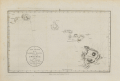 | Details | Harrison, John | 1784 |
| A New Chart of the Sandwich Islands including oWhyhee Hawaii |
|
Harrison, John |
|
| 1784 |
| LOC:130 |
| $1,100.00 | Harrison--John | A-New-Chart-of-the-Sandwich-Islands-including-oWhyhee-Hawaii | Engraved chart of the Hawaiian Islands issued shortly after the publication of the official account of Captain Cook’s third voyage (James King; June, 1784). This chart was published one month later in London by Harrison & Co., on July 1, 1784. It traces the routes of Cook’s ships Resolution and Discovery through the Hawaiian archipelago and highlights “oWhyhee” (Hawaiʻi), where Cook met his death in February 1779.
<br><br>
Based closely on Henry Roberts’ official chart but without the inset of Kealakekua Bay, Harrison’s version was created for a popular audience eager for news of the famous explorer’s final journey.
The map offers one of the earliest separately issued depictions of the Hawaiian Islands, capturing the moment when they first entered European geographic consciousness.
<br><br>
Printed from a finely engraved copper plate, the chart combines geographic accuracy with contemporary drama, naming each island and noting Cook’s fatal landing. Examples of this edition are far scarcer than those bound in the official voyage atlas, making it a sought-after piece for collectors of Pacific exploration and early Hawaiian cartography.
<br><br> |
| 7984 | 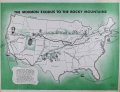 | Details | Howells, Rulon S. | 1961 |
| Map of The Mormon Exodus to the Rocky Mountains |
|
Howells, Rulon S. |
|
| 1961 |
| LOC: |
| $300.00 | Howells--Rulon-S- | Map-of-The-Mormon-Exodus-to-the-Rocky-Mountains | Scarce mid-20th-century educational wall poster depicts the westward migration of the Mormon pioneers from the eastern United States to the Great Salt Lake Valley. The map traces multiple overland and sea routes—from early settlements in New York, Ohio, and Illinois across Iowa, Nebraska, and Wyoming to Utah—with fine line work and green-toned shading that visually emphasizes the journey’s progression.
<br><br>
Illustrations along the route show covered wagons, handcarts, and pioneer figures, while smaller vignettes depict scenes such as the Mormon Battalion’s march and seaborne emigrant routes from Europe. At lower left, a narrative block summarizes the migration’s history, noting Brigham Young’s leadership and the founding of the Great Salt Lake settlement in 1847.
<br><br>
Printed in green and black on white stock, the map carries the imprint: “A Teaching Aid – The Mormon Story – Teaching Aids, Inc., Highland Park, Illinois.” This poster was likely used in classrooms and religious education settings during the 1960s, part of a broader trend toward illustrated historical maps as visual teaching tools. An attractive and informative example of mid-century American educational cartography.
<br><br>
Published by Bookcraft, Inc, 1961. |
| 7875 | 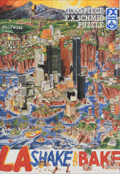 | Details | Holladay, John | 1992 |
| Rare Apocalyptic Los Angeles After Earthquake Puzzle |
|
Holladay, John |
|
| 1992 |
| LOC: |
| $385.00 | Holladay--John | Rare-Apocalyptic-Los-Angeles-After-Earthquake-Puzzle | Scarce and fun 1000 piece pictorial puzzle titled LA Shake and Bake, created in 1992 by illustrator John Holladay and published by F. X. Schmid. Puzzle is unopened in original shrink wrap as issued. <br><br>The puzzle presents a satirical pictorial view of Los Angeles shattered by a massive quake, with districts sliding toward the Pacific Ocean in a dense and humorous cartoon style. The image plays on long standing California earthquake lore. It was also issued by Schmid as an uncut poster. When assembled, the puzzle measures 26.5 by 17.25 inches.<br><br>
Holladay's theme draws on the popular misconception that California might someday break off along the San Andreas Fault, an idea that traces back to public misunderstanding of Andrew Lawson's 1906 report describing lateral motion after the San Francisco earthquake. His phrasing that the Pacific side moved northward relative to the American side echoed for decades, inspiring exaggerated public fears and giving artists like Holladay fertile ground for satirical disaster scenes. The puzzle captures that cultural myth with vivid color and a chaotic, engaging layout.<br><br>
LA Shake and Bake also reflects the long publishing history of F. X. Schmid, founded in Munich in 1860 and best known for toys, cards, and later board games and puzzles. By the 1970s and 1980s the company had expanded internationally, including a U.S. division that produced widely distributed puzzles like this one. Financial pressures in the mid 1990s led to a 1997 merger with Ravensburger, marking the end of Schmid as an independent maker. This puzzle stands as one of the imaginative late period Schmid releases, combining contemporary humor, geological lore, and striking packaging design.
<br><br>
Box size roughly 15.5" x10". |
| 8088 |  | Details | Suchy, Arthur Bartholomew | 1940 |
| Stunning Map Cayo Hueso Key West Florida Collectors Edition |
|
Suchy, Arthur Bartholomew |
|
| 1940 |
| LOC:141 |
| $875.00 | Suchy--Arthur-Bartholomew | Stunning-Map-Cayo-Hueso-Key-West-Florida-Collectors-Edition | Large original Arthur Suchy pictorial birds-eye map of Cayo Hueso or Key West, Florida. Printed in black ink. Designed, executed, produced and first copyrighted by Arthur Suchy ca. 1938. Purchased from Suchy's estate liquidation. Watermarked "Linweave TEXT Made in USA". Rarely have we seen a map of this age in such pristine condition.
<br><br>
Suchy identifies alphabetically and numerically over 70 locations that surround the view including:
<div class="indenttextblocksingle">
<ul style="list-style-type: circle;"></li>
<li>Cigar factories</li>
<li>P.A.A. Airport</li>
<li>Turtle crawls</li>
<li>Fish market</li>
<li>Warbler (helpful tug)</li>
<li>Pepe's coffee shop</li>
<li>Delmonico's</li>
<li>Key West radio station</li>
</ul>
</div>
Arthur Bartholomew Suchy (1901 - 1995) produced two editions of his famous map of Cayo Hueso- this, the first larger-size Collectors Edition was produced in a limited quantity of 100 copies dated to 1940. As Suchy received orders for the maps he would hand color each map before shipment.
<br><br>
The second and smaller edition was printed in red ink to 1941. [1] Includes numerous historical notes about Key West.
<br><br>
Suchy was issued a copyright for the Collectors Edition on Dec. 14, 1938.
<br><br>
[1] David Rumsey Map Collection at Stanford University Libraries |
| 7864 | 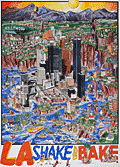 | Details | Holladay, John | 1992 |
| Pictorial Poster View of Los Angeles Submerged After Earthquake |
|
Holladay, John |
|
| 1992 |
| LOC:89 |
| $800.00 | Holladay--John | Pictorial-Poster-View-of-Los-Angeles-Submerged-After-Earthquake | Fine medium-format satirical poster of Los Angeles titled LA Shake and Bake, created in 1992 by illustrator John Holladay. Very rare, with no institutional holdings found in WorldCat and no recorded sales of the poster on the Internet. <br><br>The artwork presents a dramatic cartoon vision of the city shattered by a massive quake, with hills cleaving open, and whole neighborhoods transformed into islands in a rising blue sea. Holladay fills the sheet with humorous detail, from boats navigating through canyon walls to crowds celebrating on newly formed shorelines. The Hollywood Hills, downtown high rises, and coastal districts are all reimagined as fragments of a fractured landscape, creating a lively blend of regional caricature and disaster fantasy that reflects long standing popular myths about California earthquakes.<br><br>
Issued by Holladay Prints independent of the moderately rare F. X. Schmid puzzle edition (in stock 12/25), this poster allows the viewer to appreciate the full composition without the grid of puzzle cuts. The image captures the playful anxiety of early 1990s Los Angeles culture, shaped by real seismic events like the 1992 Landers sequence and by public misconceptions that California might one day fall into the Pacific. With its bright palette, dense pen work, and packed narrative scenes, LA Shake and Bake stands as a memorable example of late twentieth century pictorial satire devoted to one of America’s most iconic urban landscapes. |
| 1090 | 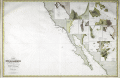 | Details | Robiquet, Aime | 1856 |
| Rare Antique French Chart of the California Coast and Baja Peninsula |
|
Robiquet, Aime |
|
| 1856 |
| LOC:68 |
| $3,000.00 | Robiquet--Aime | Rare-Antique-French-Chart-of-the-California-Coast-and-Baja-Peninsula | Very rare engraved chart of the California coast from Shelter Cove south to Mazatlan, Mexico: "Carte des Côtes de Californie de Mazatlan à San Francisco d'Après les derniers Travaux Amércains Par Robiquet, Hydrographe Rue Pavée Saint Andre No.2. Paris 1856". This large chart is particularly interesting for its collection of numerous inset plans of North American West Coast ports and bays during the late California Gold Rush.
<br></br>
Coverage includes the <b>Baja Peninsula</b> or "Vieille Californie" with Cabo San Lucas ("Cap St. Lucas") at the end. Contains inset plans of the bays and ports at Guaymas, Ballena, St. Bartholomé, Pulpito, San Quentin, San Diego, San Pedro, Monterey, San Francisco, and Bodega Bay.
<br></br>
Scarce and detailed map of California's coastline, with much detail for navigation and a few inland landmarks. Printed in Paris by French hydrographer and publisher Louis Antoine Robiquet. Presumably from Robiquet's "Atlas Hydrographique" of 1856, but this printing with separate price (4 francs) and publisher's blind stamp in bottom right margin. Only one institutional copy is recorded in WorldCat.
<br></br>
Inset plans include: (1): Baie Bodega Levé en 1839 par Ed. Belcher. (2): Plan de la Baie de Monterey Levé en 1837 par Mr. De Tessan, Ingr. Geographe. (3): Entrée du Port de San Francisco par Cadwalader Ringgold. (4): San Pedro par James Alden 1852. (5): Entrée de San Diego par R.D. Cutts et G. Davidson. (6): Port San Quentin Levé in 1839 par Ed. Belcher. (7): Port St. Bartholomé Levé par le Cape. H. Kellet en 1847. (8): Mouillage Pulpito par le Cape. H. Kellet. (9): Port Balleno par le Cape. H. Kellet. (10): Guaymas Levé par Mr. Fisquet en 1840.
<br></br>
No. 61. Paris - Imp. Louis |
| 50 | 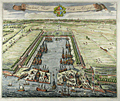 | Details | Kip, Johannes | 1728 |
| Howland Great Dock near Deptford |
|
Kip, Johannes |
|
| 1728 |
| LOC:141 |
| $800.00 | Kip--Johannes | Howland-Great-Dock-near-Deptford | A scarce early 18th century engraved view of the Howland Great Wet Dock (later Greenland Dock) at Rotherhithe, depicting one of the earliest purpose built wet docks in England and a key stage in London's transition from medieval tidal wharfage to enclosed, engineered dock systems. This view has margins > 3 inches. Shown from an elevated birds eye perspective, the composition centers on the rectangular dock basin with its lock entrance to the Thames, where vessels remain afloat at constant water level, a significant technical advance for fitting out, repair, and long term mooring. The surrounding slips, yards, cranes, and ancillary structures are rendered with functional clarity, presenting the dock as modern working infrastructure rather than a picturesque river view.<br><br>
The landscape context is especially revealing. The dock is set amid extensive tree cover and open ground, reflecting the still semi rural character of Rotherhithe in the late 17th and early 18th century. At this date, heavy maritime industry coexisted directly with pasture, orchards, and managed estate land, long before the dense urbanization of the later Georgian docks. The trees are therefore not decorative additions but accurate markers of an early industrial riverside landscape.<br><br>
The wooded setting also had practical importance. Trees stabilized soft riverbank soils and reclaimed ground, and acted as windbreaks for the exposed basin. Their orderly placement reinforces the docks role as a planned improvement, signaling permanence, investment, and control rather than ad hoc industrial growth. Engraved by Johannes Kip, the view combines topographical accuracy with a promotional intent, asserting the technical competence and commercial ambition behind one of London's earliest modern docks.<br><br> |