| | Thumbnail | | Creator | Date | Title / Author / Date / Location | Price | | | Description |
| 934 | 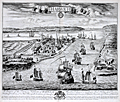 | Details | Kip, Johannes | 1724 |
| Antique birds-eye view of Harwich, England in Essex |
|
Kip, Johannes |
|
| 1724 |
| LOC:0 |
| $0.00 | Kip--Johannes | Antique-birds-eye-view--of-Harwich--England-in-Essex | SOLD
<br></br>
Large, very attractive antique engraved birds-eye view of Harwich, England in the county of Essex. Published in 1724 by well-known British engraver Johannes (Jan) Kip.
<br></br>
Legend at bottom is keyed alphabetically to the important features in the view, specifically:
<div class="indenttextblock">
<ul style="list-style-type:none">
<li>A. The Queen's yard and store house</li>
<li>B. The Queens Key</li>
<li>C. St. Nicholas Church</li>
<li>D. The Towne Hall</li>
<li>E. The Gate leading to London and the Fire Light house over it</li>
<li>F. The Candle Light house</li>
<li>G. Landguard Fort</li>
<li>H. The harbour behind the Towne and the river leading to Maningtree</li>
<li>I. Orvell Station</li>
<li>K. The river leading to Ipswitch</li>
<li>L. The Pacquett Boat (Packet boat)</li>
<li>M. The breakers</li>
<li>N. West street</li>
<li>O. Shotley Gate house</li>
<li>P. Shotley Church</li>
</ul>
</div>
Seller's attribution reads: "Sold by Thomas Taylor at the Golden Lyon near the Horn Tavern, Fleet Street and by Robert Hulton at the corner of Pall Mall over against the Hay Market St. Jameses. |
| 50 | 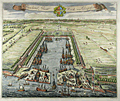 | Details | Kip, Johannes | 1728 |
| Howland Great Dock near Deptford |
|
Kip, Johannes |
|
| 1728 |
| LOC:141 |
| $800.00 | Kip--Johannes | Howland-Great-Dock-near-Deptford | A scarce early 18th century engraved view of the Howland Great Wet Dock (later Greenland Dock) at Rotherhithe, depicting one of the earliest purpose built wet docks in England and a key stage in London's transition from medieval tidal wharfage to enclosed, engineered dock systems. This view has margins > 3 inches. Shown from an elevated birds eye perspective, the composition centers on the rectangular dock basin with its lock entrance to the Thames, where vessels remain afloat at constant water level, a significant technical advance for fitting out, repair, and long term mooring. The surrounding slips, yards, cranes, and ancillary structures are rendered with functional clarity, presenting the dock as modern working infrastructure rather than a picturesque river view.<br><br>
The landscape context is especially revealing. The dock is set amid extensive tree cover and open ground, reflecting the still semi rural character of Rotherhithe in the late 17th and early 18th century. At this date, heavy maritime industry coexisted directly with pasture, orchards, and managed estate land, long before the dense urbanization of the later Georgian docks. The trees are therefore not decorative additions but accurate markers of an early industrial riverside landscape.<br><br>
The wooded setting also had practical importance. Trees stabilized soft riverbank soils and reclaimed ground, and acted as windbreaks for the exposed basin. Their orderly placement reinforces the docks role as a planned improvement, signaling permanence, investment, and control rather than ad hoc industrial growth. Engraved by Johannes Kip, the view combines topographical accuracy with a promotional intent, asserting the technical competence and commercial ambition behind one of London's earliest modern docks.<br><br> |