| | Thumbnail | | Creator | Date | Title / Author / Date / Location | Price | | | Description |
| 8023 | 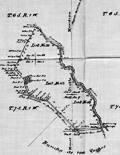 | Details | Lewis, William J. | 1880 |
| MS Copy Plat of El Potrero Land Grant Santa Clara California Silicon Valley |
|
Lewis, William J. |
|
| 1880 |
| LOC:89 |
| $0.00 | Lewis--William-J- | MS-Copy-Plat-of-El-Potrero-Land-Grant-Santa-Clara-California-Silicon-Valley | SOLD<br><br>Extremely rare manuscript copy of the official plat of the 1,939-acre Rancho El Potrero de Santa Clara, a Mexican land grant in what is now Silicon Valley. This certified true copy preserves the text and certification sequence of the 1860 survey approved by U.S. Surveyor General J.W. Mandeville and Deputy Surveyor Wm. J. Lewis, documenting the boundaries of the rancho during the adjudication of Mexican-era land claims. <br><br>Drawn in brown iron-gall ink on translucent tracing cloth, it records acreage, boundary statements, and the approvals from the Surveyor General’s Office in San Francisco. Shows the Santa Clara Mission (established 1777) and the Alameda or road between Santa Clara and San Jose. At bottom center, the circled “L.S.” marks the <i>locus sigilli</i>, indicating where the Surveyor General’s seal belonged. Clerks routinely added this symbol on vellum and tracing-cloth copies, confirming the sheet’s status as an officially certified government plat.<br><br>
Although the certifications date to 1861, this is not the original field survey but an office copy produced as the Land Office worked to finalize Mexican land-grant case files. Beginning in the 1870s, earlier surveys were systematically recopied onto durable tracing cloth so blueprint-ready masters could be archived, filed with county recorders, and used in issuing land patents. Paper and thin-linen plats deteriorated quickly; tracing cloth provided a stable medium suited to long-term preservation and reproduction.<br><br>
Physical features confirm the tracing dates to the early 1880s rather than 1861: the fine red marginal ruling at far right, smooth machine-finished cloth, oxidized iron-gall ink, and the narrow Land Office folding pattern adopted after about 1878. |